
























Our mission here at RealCraft is to spearhead a return to craftsmanship—and that includes glasswork and blacksmithing. As a specialty woodworking company, we make a point of partnering with other artisans who practice time-honored arts and crafts.
Why? Because things done the old-fashioned way carry a soulful quality. They have a different energy, with an authenticity that modern imitations can’t replicate. Heritage crafts stand out in an increasingly mass-produced, impersonal world. They bring warmth, personality, and enhanced value to a home.
And when it comes to the different materials that make up a home, it’s hard to think of anything more distinctively traditional than stained glass. Associated with the great cathedrals of Europe, the artwork of Louis Comfort Tiffany, and the Arts and Crafts movement, it lends a handmade, elevated feeling wherever it’s found.
So, here are seven surprising facts about stained glass, from its mysterious origins to the present day.
Stained glass dates back thousands of years. But its true origins are shrouded in mystery.
As befits an ancient craft, we don’t entirely know where or how stained glass originated. Some historians believe it to be the result of an accidental discovery in Egypt or Mesopotamia when potters were firing their vessels. Others believe it had to do with jewelry making.
In Europe, the art form of stained glass came into its own in the medieval and Renaissance periods. Since glass is breakable, a lot of medieval stained glass survives only in fragments. So, much of what we know about glasswork during this period comes from a document called On The Various Arts, written in the 12th century by a German monk under the pseudonym Theophilus. Who Theophilus actually was is--you guessed it--a mystery. Some historians believe that Theophilus was an artisan as well as a monk, and likely a metalworker, since the sections on glass and gold smithing seem to be written by someone with firsthand knowledge.
And unlike most other art forms, stained glass has changed very little compared to Theophilus’ time. Methods and techniques from centuries ago are still used today.

Historical stained glass had wood in it—wood ash, that is.
Stained glass makers were usually located near woodlands and forests, since they used wood to make ash, one of their raw materials. Their workshops were called glasshouses. In the old days, the artisans who painted the glass typically purchased colored glass sheets from the glasshouses.
From about the year 1000 onwards, glass makers largely used wood ash in glass production. This resulted in glass which was not as robust as the kind of glass you find today in standard doors and windows. Stained-glass windows would often break. They needed regular repairs and restoration. Many of the stain glass windows from medieval or ancient times survive only in fragments or as replicas.
Stained glass windows are a collaborative art form.
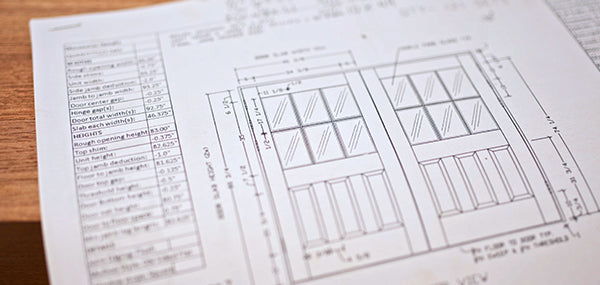
Stained glass always starts with a design drawing. In the medieval period, it was called a vidimus, which is Latin for “we have seen”. The advent of paper rather than wood as the drawing surface helped allow for recreations of the same design. Traveling glass artists could replicate images for churches in different regions. But the artisan who crafted the glass window wasn’t always the designer. Sometimes they were. Other times, whoever commissioned the work would give the glass makers designs drawn by other artists. This is frequently still the case today.
And it mirrors what we do here at RealCraft as woodworkers. We come up with our own designs, but we also collaborate with designers, homeowners, and architects to create something unique. Often when a client is looking for custom glass, it is a collaborative process between our design team, the client and their team, and our glass makers. We balance creative visions with practical concerns, such as whether or not a door has to have insulated glass. We may also have to consider how the color(s) of the glass interacts with the tone of the chosen wood species.

Stained glass gets its vibrant colors from different metals and minerals.
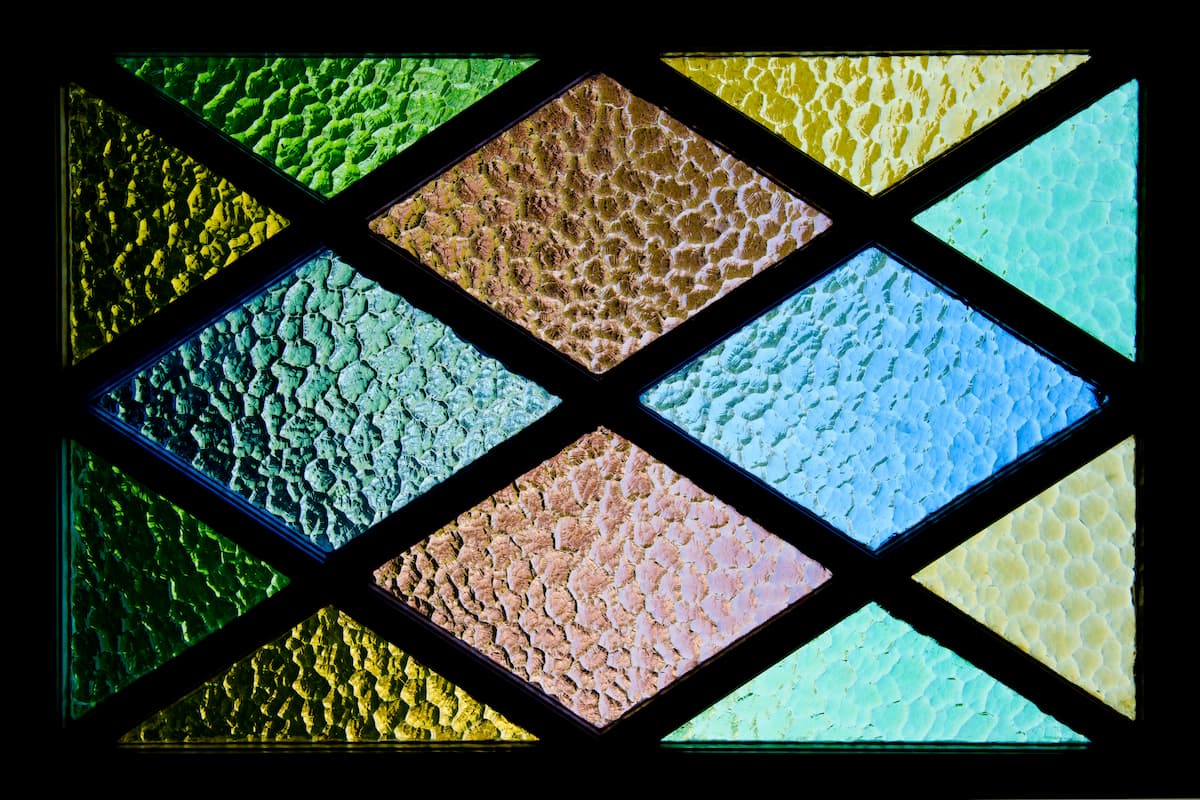
Powdered metals added to the glass while it is still molten change the color. Some of these coloring agents are counterintuitive. For instance, red comes from very low concentrations of gold. (Red can also be made with selenium or copper). Dark green, like the color of wine bottles, comes from chromium. And blue comes from nickel or Sulphur.
The term 'stained glass' comes from silver.
So why is stained glass referred to as ‘stained’? That moniker comes from silver. When applied to glass, silver literally stains the glass yellow or orange. Silver compounds are mixed with a binding agent, then applied to the surface of glass, and then fired in a furnace or kiln. Silver stain came around as an innovation in 1300. See an example of its vibrant yellow color below.

Stained glass is traditionally fastened with lead, but there are other options.
H-shaped pieces made of lead called “cames” unite the colored glass panels into a design. The lead cames are then soldered together to make the panel secure. While lead should be treated carefully, leaded glass does not pose the same hazards as lead paint or other lead coatings commonly used before 1978. This is because it won’t flake and become airborne dust that a person can breathe or ingest. But if you’d rather avoid lead altogether, you can also use stained glass without lead fastenings--though it won’t look as traditional. Many times, the leaded glass we use is insulated, or sandwiched between two other layers of clear glass, for enhanced durability and peace of mind.
RealCraft Reserve offers stained, colored, and other custom glass options for your custom door.
We work with local artisans who specialize in traditional stained and leaded glass for designs done with RealCraft Reserve. Reserve is our fully custom service for unique and original doors. From specialty glass to unusual shapes to custom panel options, we manifest your most creative design dreams.
If you're ready to bring your design to life, start by filling out our quick and easy custom door quote form. You'll get a complimentary door quote from one of our expert design consultants.



Leave a comment (all fields required)